

Structured Cabling For Intelligent Buildings
Case Studies
Explore more of our case studies
Project Overview
Client: JJ Foodservice (UK)
Location: Enfield, UK
Sector: Foodservice wholesale & distribution
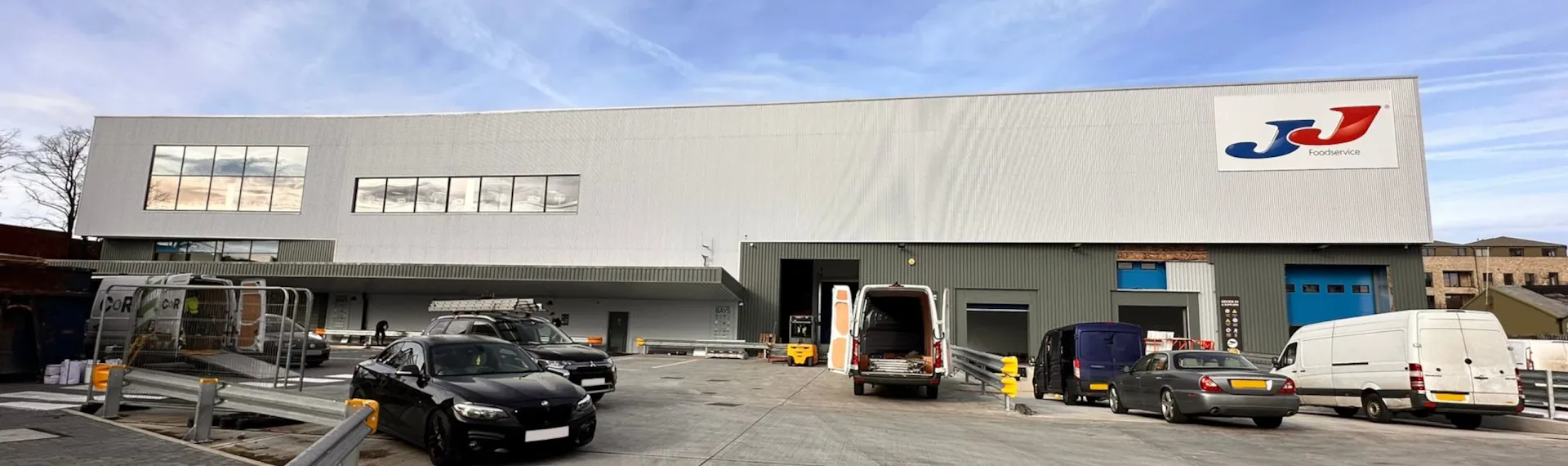
As JJ Foodservice expanded its logistics network to meet rising national demand, the company invested in a state-of-the-art refrigerated warehouse — a site designed to optimise cold-chain operations while integrating the latest in digital connectivity, monitoring, and automation.
The new facility needed to deliver the same reliability and operational visibility that defines JJ’s reputation across the UK — but at a far larger and more technically demanding scale.
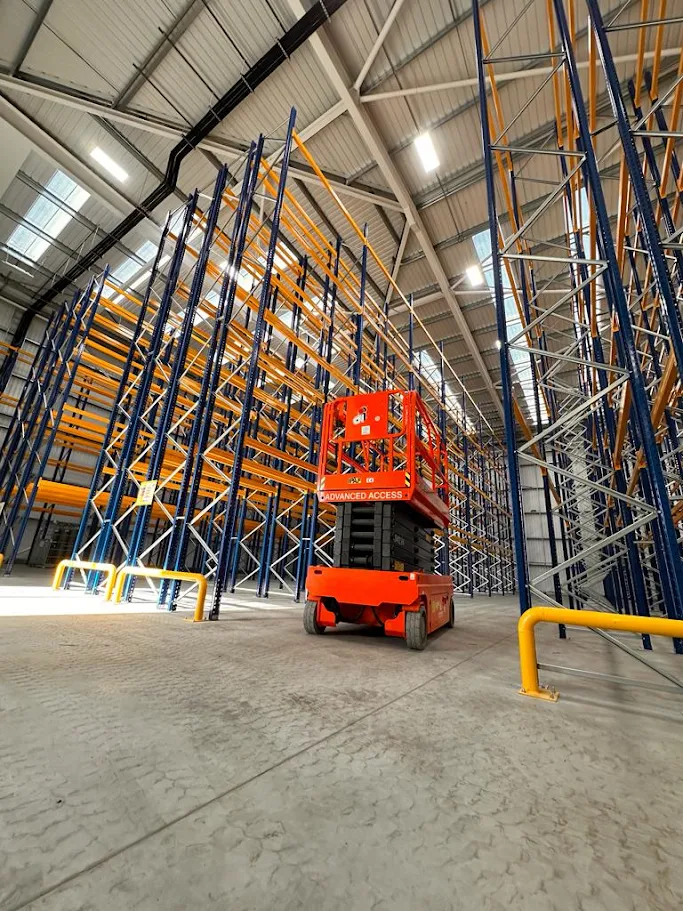
Operating in a temperature-controlled environment introduced distinctive challenges. Cabling and equipment had to perform reliably in sub-zero conditions, while 12-metre-high steel racking created complex radio environments for Wi-Fi and sensor connectivity. Critical operational systems — from handheld picking devices and security cameras to temperature sensors and logistics controls — all depended on a resilient, intelligent-building network backbone.
To achieve this, JJ Foodservice partnered with Cyberware to design and implement a fully integrated infrastructure combining structured cabling, wireless connectivity, CCTV, and IoT systems into a single, unified platform.
The project encompassed:
- Structured cabling designed and installed to ISO/IEC 11801-6 for intelligent-building systems.
- Dual-rack network architecture providing core redundancy and failover.
- Industrial-grade Wi-Fi coverage throughout high-racking and freezer zones.
- Integrated CCTV with both local and long-range connectivity.
- Wireless point-to-point links extending surveillance to remote perimeter locations.
- Infrastructure prepared for ongoing monitoring and lifecycle management by Cyberware’s operations team.
The result was a digitally enabled warehouse capable of supporting real-time data flow between people, devices, and systems — a foundation engineered for reliability, scalability, and long-term service continuity.
The Challange
Building a fully connected, intelligent warehouse inside a cold-chain environment presented a unique mix of technical and environmental constraints. Vast open spaces, towering steel racking, and temperature-controlled zones ranging from chilled to deep-freeze created conditions where both cabling and wireless signals were constantly tested.
Traditional Wi-Fi layouts performed poorly in such environments. Steel structures disrupted radio propagation, while freezer zones restricted cable routes and required materials rated for continuous sub-zero operation.
The warehouse also needed to host multiple converged systems — Wi-Fi, CCTV, digital signage, sensors, and operational controls — all running reliably over the same physical backbone, each with distinct performance and redundancy requirements.
This was a mission-critical logistics hub, where downtime could disrupt national fulfilment. The network therefore had to be resilient by design, incorporating dual-rack cores, redundant switching, and failover pathways from the outset.
Even seemingly simple details — such as equipment mounting at 12-metre heights or condensation control — demanded bespoke bracketry and containment solutions.
In short, this was not a conventional installation. It was the creation of a high-availability communications ecosystem, engineered to perform flawlessly in one of the most demanding environments for network technology.
Our Approach
Cyberware’s strength lies in combining hands-on service-provider expertise with formal ISO-aligned engineering practice.
Because we actively deliver and manage Wi-Fi, CCTV, and IoT services across multiple estates, our designs are shaped by real-world operational performance rather than assumptions.
We understand how networks behave once live — where interference emerges, how latency affects live video, and how environmental factors like condensation or metal racking influence signal propagation and cable performance.
Built to International Standards
The JJ Foodservice project formed part of Cyberware’s intelligent-building framework, aligning with ISO/IEC 11801-6 — Distributed Building Services Cabling. This standard defines how cabling infrastructure supports integrated systems such as Wi-Fi, CCTV, and IoT, ensuring interoperability and scalability as new technologies are introduced.
Testing, Verification and Certification
Every structured cabling system must be validated, but the level of validation depends on assurance and warranty requirements. Cyberware provides all three recognised levels:
Testing
confirms wiring integrity, polarity, and continuity.
Verification
Confirms electrical performance and bandwidth capability for the intended data rate (e.g., 1 Gb/s or 10 Gb/s).
Certification
Provides full standards-based analysis to ISO/IEC 11801 limits using calibrated instruments such as the Fluke DSX series, generating pass/fail reports suitable for manufacturer warranty.
For JJ Foodservice, verification testing provided the right balance of assurance, speed, and efficiency. Each link was verified and recorded to confirm performance across all temperature zones, ensuring robust connectivity without unnecessary overhead.
Where manufacturer or client requirements demand, Cyberware also offers full Fluke-certified testing with supporting documentation.
Building a Resilient, Standards-Based Network Backbone
The JJ Foodservice infrastructure was designed as a high-availability digital backbone, capable of supporting Wi-Fi, CCTV, and IoT systems under the extreme conditions of a cold-chain environment. From structured cabling to wireless backhaul, every layer was engineered for scalability, redundancy, and continuity, ensuring the network could evolve alongside future operational requirements.
Resilient Cabling Architecture
A structured cabling system is more than physical infrastructure — it is an investment in the building’s long-term utility and digital capability. At JJ Foodservice, the network was built to ISO/IEC 11801-6, creating a unified backbone for Wi-Fi, CCTV, sensors, and control systems. The design incorporated a redundant dual-core architecture with mirrored switch stacks and multiple pathways to maintain uptime during maintenance or equipment failure. Cable routing and containment followed BS EN 50174-2, ensuring proper bend control, safe separation, and electrical integrity within a busy operational environment. The result is an infrastructure capable of supporting current and future technologies — from expanded automation to higher data-rate applications — without disrupting daily operations.
Wireless Backhaul and Remote CCTV Integration
To extend connectivity beyond the warehouse envelope, Cyberware deployed a dedicated wireless backhaul layer linking remote and perimeter CCTV cameras. Primary links used 60 GHz millimetre-wave radios, providing multi-gigabit throughput and near-zero latency for live, high-definition video. Each connection was backed by a 5 GHz failover path, delivering automatic redundancy during interference or weather-related degradation. This hybrid approach allowed cameras located more than two kilometres from the main facility to integrate seamlessly with the central monitoring system, maintaining synchronised, high-quality video across the estate.
Operational Integration
The completed network unified all building systems — Wi-Fi, CCTV, environmental sensors, and digital signage — within a single managed infrastructure. Designed for long-term adaptability, it offers clear service segregation, simple scalability, and continuous optimisation as JJ Foodservice’s digital ecosystem evolves.
By combining structured cabling, wireless connectivity, and active monitoring under one intelligent framework, Cyberware delivered not just a network, but a living infrastructure built to grow with the business.
The Outcome
The JJ Foodservice warehouse now operates on a resilient, intelligent-building infrastructure built to international standards and verified for real-world performance.
The network underpins every operational system — from Wi-Fi and CCTV to temperature sensors and logistics control — and provides a scalable foundation for future digital transformation.
Key outcomes include:
Verified performance and reliability:
Each link validated to ensure consistent throughput and stability, even in cold-store environments with heavy structural interference.
Operational resilience:
Dual-rack redundancy and segregated network paths provide continuity for mission-critical systems and surveillance.
Future-proof design:
Structured backbone supports IoT growth, higher-bandwidth applications, and integration of emerging building technologies.
Standards-based assurance:
Cabling designed and installed in alignment with ISO/IEC 11801-6 for intelligent-building systems, ensuring interoperability and long-term service compatibility.
Service-ready architecture:
Built for ongoing Cyberware management, enabling proactive monitoring, analytics, and performance optimisation.
The project demonstrates how a service-led, standards-aligned approach delivers more than connectivity — it delivers the intelligence, reliability, and flexibility that modern facilities depend on.
OUR CLIENTS
















Get IN TOUCH TODAY! Wi-Fi, CCTV, access, or cloud — whatever your challenge, we’ll make it simple.
© 2026 Cyberware Ltd. All rights reserved.
Cyberware Ltd is a company registered in England and Wales.
Registered Office: Allia Future Business Centre, London Road, Peterborough, Cambridgeshire, England, PE2 8AN
Company Number: 03160139
[Privacy & Cookie Policy] | [Terms of Use]